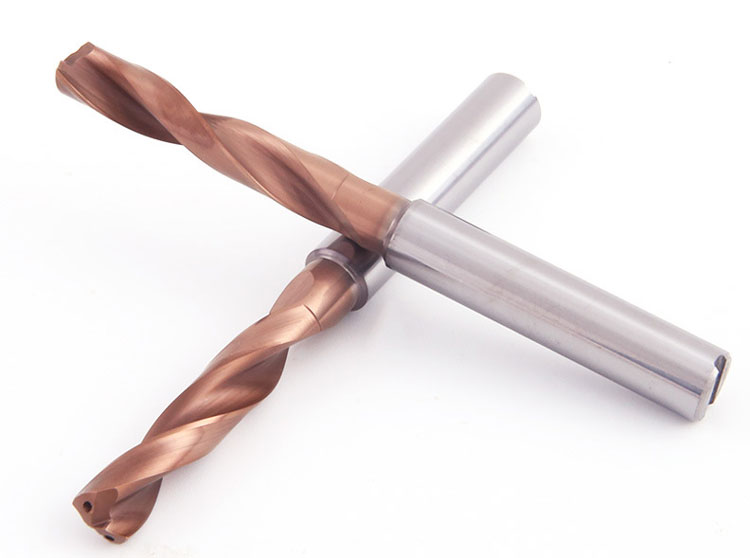
If you’ve ever looked closely at a high-performance drill bit and noticed tiny holes running through its body, you might have wondered—why are those there?
The answer is simple but powerful: internal coolant holes. These strategically engineered holes play a huge role in improving drilling performance, especially in CNC and deep-hole machining. In this blog post, we’ll explore why coolant-through drill bits are used, how they work, and when they’re worth the investment.
1. What Are Drill Bits with Coolant Holes?
Drill bits with coolant holes—also known as through-coolant drill bits—are tools designed with one or more internal channels that deliver cutting fluid (coolant) directly to the cutting edge of the drill.
These holes typically run from the shank of the tool all the way to the tip, allowing high-pressure coolant to flow through during operation.
2. Why Use Coolant-Through Drill Bits?
Let’s break down the real-world benefits.
✅ Improved Heat Dissipation
Drilling, especially at high speeds, generates significant heat at the cutting edge. Traditional flood coolant systems can’t always reach deep into the hole or deliver coolant fast enough.
Internal coolant holes deliver fluid directly where it’s needed, cooling the cutting edge instantly and preventing thermal damage or rapid tool wear.
“According to Sandvik Coromant, internal coolant improves tool life by up to 50% in many applications.”
✅ Better Chip Evacuation
One of the biggest challenges in deep-hole drilling is chip buildup. Chips can clog the hole, cause friction, and lead to tool breakage or poor surface finish.
With coolant fed through the drill, chips are flushed out more effectively, maintaining consistent cutting and protecting the tool.
✅ Higher Cutting Speeds and Feed Rates
Because internal coolant keeps the cutting edge cooler and the chips moving, you can increase both your speed and feed without sacrificing hole quality.
This leads to shorter cycle times and higher productivity, which is essential in high-volume production environments.
✅ Superior Hole Quality
By maintaining stable temperatures and clearing chips efficiently, coolant-through drills help produce straighter, cleaner, and more precise holes.
This is critical in industries where tolerances are tight—like aerospace, automotive, mold-making, and precision engineering.
3. When Should You Use a Drill Bit with Coolant Holes?
Coolant-through drills aren't needed for every job, but they’re ideal in the following cases:
Deep-hole drilling (more than 3x diameter depth)
Hard-to-machine materials (e.g. stainless steel, titanium, Inconel)
High-speed machining
Close tolerance or high-finish requirements
Heat-sensitive workpieces
Automated or unattended CNC operations
4. Types of Coolant Delivery Systems
There are generally two types of coolant systems used with these drills:
External High-Pressure Coolant Systems: Pumps coolant through the spindle and into the drill’s internal channels.
Minimum Quantity Lubrication (MQL): Uses a small amount of air-oil mist, effective in dry or near-dry machining environments.
Your machine must be equipped with through-spindle coolant (TSC) to use internal coolant drills properly.
5. Is It Worth the Cost?
Yes—if your operation involves deep holes, tough materials, or production machining.
Though coolant-through drill bits are more expensive than standard drills, the ROI comes from:
Reduced tool breakage
Better part quality
Shorter machining times
Fewer scrap parts
Over time, this leads to lower total cost per hole.
6. Case Example: Machining Inconel with Coolant-Through Drill
A European aerospace subcontractor switched from HSS drills with external coolant to solid carbide drills with internal coolant for Inconel parts. The result?
Tool life increased by 3x
Hole surface roughness improved from Ra 3.2 to Ra 1.6
Cycle time reduced by 25%
This is just one example, but it shows how much difference coolant delivery can make.
Final Thoughts
If you’re struggling with overheating, poor hole finish, or tool breakage—especially in demanding materials or deep holes—coolant-through drill bits are a game changer.
At Amony, we offer a wide range of solid carbide and indexable drills with internal coolant for both general-purpose and high-performance machining. Need help choosing the right drill for your machine setup? Our team is here to support you with expert advice and fast solutions.