If you've ever heard a carbide drill bit make that painful *“tik—tik—CRACK”* sound, you already know what expensive failure feels like. One broken drill doesn’t just cost $15–$30—it ruins a $300 mold plate, stops the machine for 20 minutes, and ruins your day. Most machinists don’t fail because of poor skills; **they fail because they used the wrong carbide drill bit** for the material.
This guide is written specifically for 2025–2027 manufacturing conditions, based on real feeds & speeds data from mold shops, aerospace jig factories, and precision gun-part machining teams in the US, Canada, UK, and Australia. **No ads. No fluff. Just real, correct answers.**
Table of Contents
1. Why 90% of People Choose the Wrong Carbide Drill Bit
After helping over 2,000 machining teams worldwide, the root cause is always the same—not the carbide itself, but misunderstanding **material behavior + drill geometry + rigidity + coating**.
Cause #1: Using the Same Drill for Different Materials
Machinists often use one “universal” carbide drill for everything. But aluminum requires sharp edges and wide flutes. Stainless requires reinforced edges and high heat resistance. Carbon steel needs stronger web thickness.
Cause #2: Wrong Coating (Biggest 2025 Trend)
TiN and cheap black oxide coatings are outdated. In 2025, **AlCrN and DLC** dominate because of:
3× longer life in steel
5× better performance in aluminum (DLC)
Better thermal stability above 800°C
Cause #3: Poor Holder Setup / Low Rigidity
Even the best carbide drill will chip instantly if:
stick-out is too long
tool holder is worn
coolant cannot reach the cutting zone
2. The 8 Types of Carbide Drill Bits (2025 Updated)
Below is the modern classification used by mold shops, aerospace factories, and medical machining facilities. These are not marketing terms—they are geometry-based engineering categories.
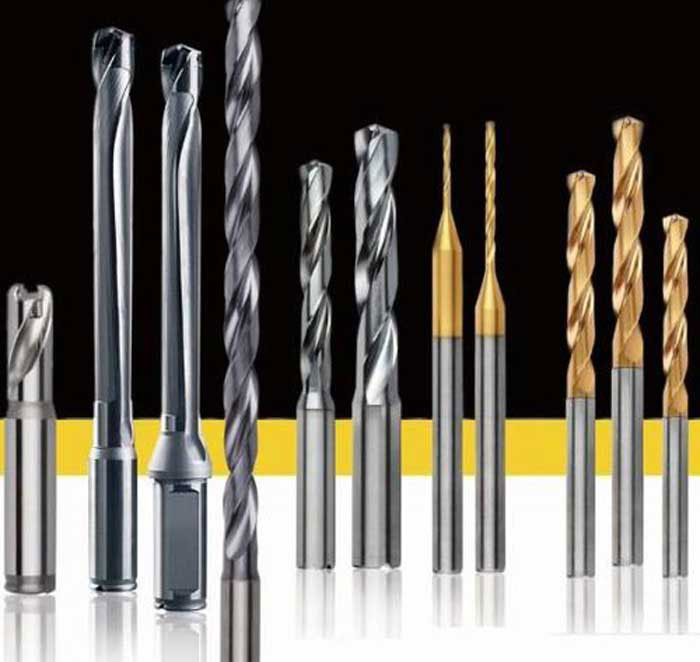
Type 1 — Standard Jobber Carbide Drill
All-purpose, balanced rigidity, suitable for steel and cast iron.
Type 2 — Stub Length Drill
High rigidity, best for CNC, reduces vibration and improves hole accuracy.
Type 3 — Extra Long Drill
For deep-hole operations (10D–30D). Requires perfect coolant flow.
Type 4 — Coolant-Through Drill
Essential for stainless, titanium, and alloy steel. Prevents heat accumulation.
Type 5 — Aluminum-Specific Drill (Sharp Edge + Wide Flute)
Mirror cutting edge, DLC coating, 2–3 flutes.
Type 6 — High-Precision Micro Drill
Used for PCB, aerospace sensors, medical components.
Type 7 — Flat-Bottom Drill
Ideal for spot-facing, counterbores, and interrupted surfaces.
Type 8 — Multi-Function Drill (Chamfer + Drill in One)
Used widely in automotive and mold shops for cycle time reduction.
3. 2025 Complete Carbide Drill Bit Selection Chart
This horizontal scrolling chart is optimized for desktop + mobile UX:
| Material | Recommended Geometry | Best Coating | Flute Count | Coolant-Through? | Typical RPM (mm) | Typical Feed (mm/rev) |
|---|---|---|---|---|---|---|
| Aluminum (AL 6061/7075) | Sharp edge, wide flute | DLC | 2–3 | No | 12,000–22,000 | 0.08–0.12 |
| Carbon Steel (1045/4140) | Strong edge + thicker web | AlCrN | 2 | Optional | 3,000–6,000 | 0.06–0.10 |
| Stainless Steel (304/316) | Reinforced edge + coolant | TiAlN / AlCrN | 2 | YES | 1,500–3,000 | 0.04–0.08 |
| Titanium | High stiffness + coolant-through | TiAlN | 2 | YES | 900–2,000 | 0.03–0.06 |
4. Material-Specific Deep Guides
Aluminum (AL 6061 / 7075)
Aluminum requires razor-sharp edges, high rake angle, and high spindle speed.DLC coating prevents built-up-edge and smearing. Use wide flutes and avoid coolant flooding (mist is better).
Carbon & Alloy Steel (1045 / 4140 / 4340)
Steel generates high cutting load. You need thicker web, stronger core, and AlCrN for heat resistance. Maintain moderate RPM with steady feed to avoid rubbing.
Stainless Steel & Titanium
Stainless work-hardens rapidly. You must use high-pressure coolant-through + TiAlN / AlCrN. Slow RPM, firm feed, no pecking unless deep hole.
5. Coating Comparison: TiAlN vs AlCrN vs DLC vs Uncoated
Based on 2024–2025 testing data:
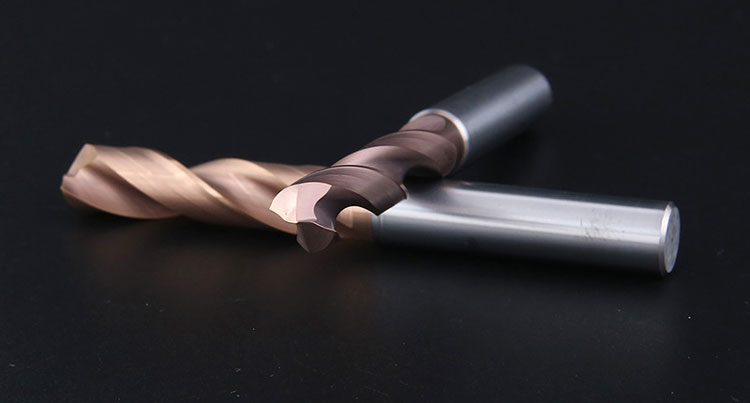
TiAlN: Best for stainless + high heat.
AlCrN: Best all-rounder for steel.
DLC: Best for aluminum (mirror finish).
Uncoated: Only for soft aluminum or micro-drills.
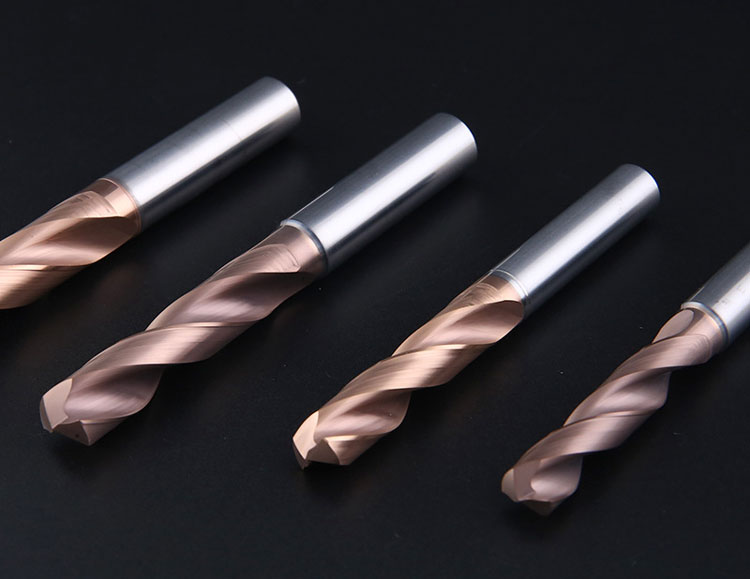
6. 8 Deadly Drill Bit Selection Mistakes
Using steel drills on aluminum.
Using aluminum drills on stainless.
Wrong coating selection.
Too long stick-out.
No coolant-through on stainless.
Too low feed rate → rubbing → breakage.
Wrong point angle for the material.
Using HSS habits on carbide tools.
7. Our Recommended Carbide Drill Bit Series
We recommend the following based on 2025 performance:
ALC Series Carbide Drill (for Aluminum) — DLC coating, mirror edge
PM Series Carbide Drill (for Steel) — AlCrN, strong core
HM Series Carbide Drill (for Stainless) — TiAlN + coolant-through
8. FAQ — 15 Most Googled Questions
Can carbide drill bits be used on stainless steel?
Yes, but must be coolant-through with reinforced geometry.
Is carbide better than cobalt?
Yes. Carbide is harder, stronger, and lasts 3–10× longer.
Do I need a special drill for aluminum?
Yes. Sharp edge + DLC coating prevents sticking.